
Inside Innovation Hubs: Why They Matter, Their Models, and How They Shape Growth
Innovation hubs are increasingly positioned as engines of economic and social transformation, bringing together startups, corporates, research institutions, investors, and policymakers to accelerate change. This trend is not centered in a single region, but it’s becoming a global phenomenon. While North America ranks among the top 100 innovation clusters, hubs in economies such as China and India are growing in strength, according to WIPO (World Intellectual Property Organization) data. Nearly half of global patent filings originate from Chinese entities, while India's ecosystems are also driving innovation in artificial intelligence, healthcare, and semiconductors.
Despite substantial investment and high expectations, many hubs fall short of their intended impact. With significant challenges such as building sustainably, closing the innovation-impact gap, and adapting to changing technologies, a rethinking of the structures of innovation centres is required. Without clear purpose, effective governance, and aligned incentives, hubs risk becoming spaces of activity rather than drivers of sustained growth.
What is an Innovation Hub?
An innovation hub is an ecosystem in which startups, venture capitalists, and research and development (R&D) institutions collaborate, share resources, and develop solutions that drive progress and address global challenges.
The case for promoting innovation hubs is compelling. McKinsey’s research shows these hubs outperform traditional business districts across economic, financial, and social metrics, while fostering healthier, more diverse communities.
Why are Innovation Hubs Created?
Innovation hubs are created to support individuals and companies in their innovation efforts through access to funding opportunities, industry networking and mentorship events, and corporate partnerships. They create greater ecosystem synergies, improve access to resources, attract talent and investment, and establish spaces conducive to innovation.
For instance, consider BATworks, a climate innovation hub led by the Los Angeles Cleantech Incubator (LACI), Cambridge Innovation Center (CIC), and the City of New York. This hub of innovation brings together private and public entities to create a space where climate-tech startups can access resources, funding, and mentorship to further develop their ideas and increase the impact of their solutions.
How to Build an Innovation Hub?
Creating a successful innovation hub requires leaders to consider three fundamentals: a clear goal, access to resources and human capital, and seamless collaboration. Getting these elements right enables hubs to deliver value not only to startups but also to the wider community, transforming ideas into measurable impact while meeting the diverse needs of all stakeholders.
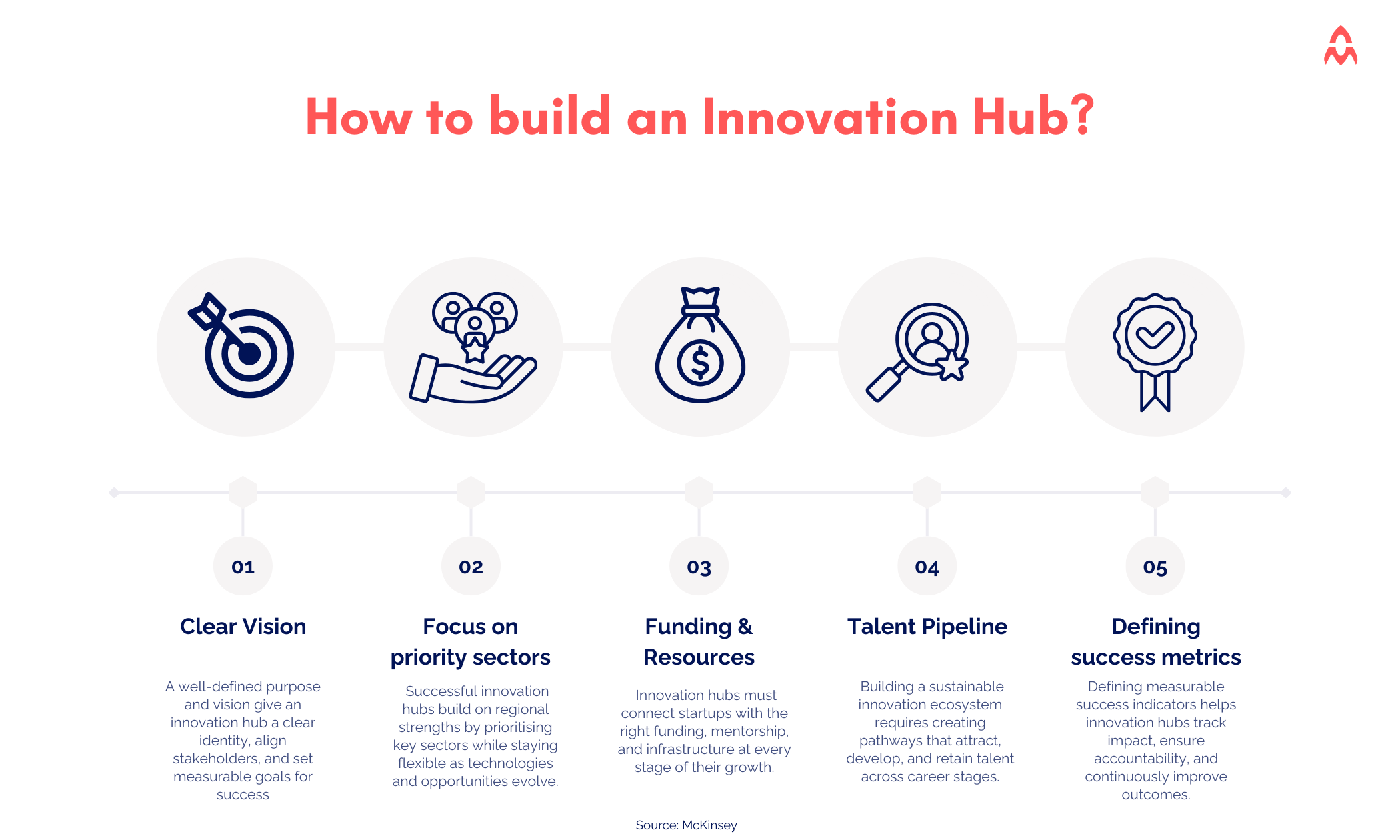
Defining a clear purpose and a vision: While ecosystems may have different goals, defining a clear identity is essential to attract and align all stakeholders around the center for innovation's purpose and the criteria for measuring its success. For instance, Futurize aims to support young students in building ventures in healthtech, climate, and energy. This clear vision aligns all stakeholders, from startups and universities to corporates, around a shared mission and concrete objective.
Focusing on priority sectors while staying flexible: McKinsey’s research found that innovation hubs are more likely to succeed when they leverage a region's existing skills, talent, and infrastructure. Defining this focus requires leaders to answer two critical questions: what can the region realistically compete in and win, and which corporations, universities, or other institutions can serve as anchor partners. Based on these answers, hubs can choose to focus on specific industries, specific technologies, or a balance of both.
Funding and resources: Startups require targeted funding and mentorship support at every stage of their journey. To this end, innovation hubs must establish robust mechanisms that connect founders with capital, mentorship, and infrastructure tailored to their development stage. This includes assessing gaps in resource allocation and fostering relationships among startups, investors, corporates, and research institutions to create collaborative opportunities that accelerate progress. At Futurize, in programs such as the Futurize Incubator and Futurize Founder Academy, startups pitch their ideas to a panel of investors, helping secure funding and mentorship.
Building a talent pipeline: When building an innovation ecosystem, attracting and retaining the right talent is crucial. Instead of relying solely on existing partnerships, focus on creating pathways that develop skills across career stages. This requires partnerships with universities, training centers, and community organizations to ensure opportunities are accessible and aligned with the hub's strategic focus. Futurize demonstrates this multi-stage approach by partnering with universities to identify promising student entrepreneurs, connecting them with corporate innovation centres for hands-on experience, and then supporting their transition into full-time roles or startup ventures. Their network of 60+ corporate partners and universities across 28 countries creates a continuous talent pipeline - students who join Futurize's Founder Academy programs are more likely to join the innovation ecosystem in meaningful roles, either as corporate innovators or founders, ensuring the ecosystem has a steady influx of trained talent rather than competing for the same limited pool of experienced professionals.
Defining success metrics: The success of an innovation hub hinges on clear measurement frameworks that track progress and demonstrate impact. They are essential for ensuring that operations align with the hub's vision, maintain accountability, and enable continuous improvement. Some metrics for leaders to consider include the number of new startups launched, products commercialized, jobs created, ecosystem diversity, and the long-term return on innovation investment.
What are the Different Innovation Ecosystem Models?
Innovation ecosystems vary widely in structure and focus. From university-led research centers to government-backed tech parks and corporate accelerators, each model reflects distinct priorities, funding mechanisms, and approaches to fostering innovation.
Business Innovation Centre: A Business Innovation Centre is a specialized space that supports startups and established SMEs at various stages of growth. These centers provide tailored workspaces, labs, mentoring, and funding support to accelerate ideas into real-world impact. Their long-term goal is to foster a culture of continuous innovation. An example is the Citi Innovation Lab, which promotes the development of new customer solutions and technologies in the finance sector.
Social Innovation Hub: Social innovation hubs support entrepreneurs and organizations working to address pressing social and environmental challenges. These hubs provide mentorship, funding, collaborative workspaces, and access to networks that help scale solutions in areas such as education, healthcare, and climate action. For instance, the Ashoka Fellowship provides early-stage social entrepreneurs with financial support and networking opportunities to expand their operations. Similarly, the Impact Hub, with locations in over 100 cities worldwide, connects social innovators with resources and partnerships to accelerate the development of their solutions.
Government-led innovation centres: Government-led innovation centres are state-supported spaces that help entrepreneurs accelerate technological development, economic growth, and industry competitiveness. What distinguishes them is the policy alignment, regulatory leverage, and broader institutional support they provide. For instance, China's Zhongguancun is a government-supported district that serves as a hub for the growth of AI, robotics, and biotechnology, supported by partnerships with leading universities such as Tsinghua and Peking.
University Innovation Centres: University Innovation Centres are specialized hubs on campuses that support startup development by providing infrastructure, mentorship, and funding opportunities. They bridge the gap between academia and industry, enabling students, researchers, and faculty to transform cutting-edge research into viable ventures. For instance, UC Berkeley's SkyDeck accelerator is recognized globally for its work in supporting startups by leveraging the institution's strong academic foundation and extensive network of industry partners.
Innovation Centres Around the World Driving Impact
Innovation Hubs worldwide are redefining how ideas can be translated into real-world impact. From London's FCA innovation hub to the Hong Kong Science Park, these innovation ecosystem examples show how collaboration can drive shared progress.
Cambridge Innovation Centre: Located in Massachusetts, the Cambridge Innovation Center has established itself as a globally renowned hub for biotech and life sciences. The centre hosts over 300 life science and biotech organizations, ranging from early-stage startups to accelerators and innovation arms of global pharmaceutical companies. Since 2001, startups associated with the hub have collectively raised over $17 billion in venture capital, demonstrating the hub's role in accelerating breakthrough innovation.
Microsoft Innovation Hub: Microsoft Innovation Hub is a global network of spaces where the company works directly with organisations to accelerate technology-led innovation, particularly in cloud, AI, and enterprise solutions. The hubs connect teams with technical experts, tailored workshops, rapid prototyping support, and industry showcases to help ideas advance from concept to implementation.
FCA Innovation Hub: The FCA Innovation Hub, run by the United Kingdom’s Financial Conduct Authority, supports fintech and financial services firms in bringing innovative products and services to market within a regulatory framework. It offers tools such as regulatory sandbox testing, tailored guidance on rules and pathways for emerging technologies, and direct engagement with regulators to help firms understand requirements and potential compliance considerations.
Hong Kong Science Park: Hong Kong Science Park is a major innovation ecosystem in Hong Kong designed to support research, development, and commercialisation of technology across sectors, including AI, robotics, fintech, biotech, and smart city solutions. Operated by the Hong Kong Science and Technology Parks Corporation, it offers R&D facilities, incubation programmes, and collaboration spaces for startups and multinational tech companies.
Establishing an innovation hub can be a powerful catalyst for economic and social transformation, especially for developing countries. However, success is not easily guaranteed. From tensions around data sharing to the overconcentration of resources in one center, several challenges limit innovation centers' ability to move beyond short-term gains to long-term, systematic impact. Despite challenges, building a robust innovation hub is not impossible. Examples such as the Cambridge Innovation Center and Microsoft Innovation Hub show how a dedicated space for ideation and collaboration can spearhead growth. A clear vision, dedicated leadership, a collaborative culture, and a supportive ecosystem can be the difference in accelerating lasting progress.
Partner with us
We are a social impact firm accelerating growth for organizations, governments & universities. Collaborate with Futurize to spearhead entrepreneurship programs, startup incubators, and inclusive innovation strategies to generate groundbreaking ideas and businesses for a sustainable future.