
What Is a Value Proposition Canvas? How to Use It, Benefits, and Frameworks
Starting a business comes with endless uncertainties, but communicating your value to customers should not be one of them. Yet most founders struggle with the same fundamental challenge: articulating exactly why a customer should choose them over anyone else.
This is when creating a Value Proposition Canvas becomes essential. In this blog, we cover the types of value proposition frameworks, key elements of the canvas, and how you, as a startup founder, can create one for your business.
What is a Value Proposition Canvas?
A value proposition canvas is a framework that helps founders align their product with what customers need and value. It helps answer the question, “Why should a customer care about my product when there are several alternatives and competitors available in the market?”
This framework offers several benefits to founders. By working through the canvas, founders can identify their ideal target audience, guide product development by addressing real customer challenges and aspirations, and build a strong foundation for future product, sales, and marketing efforts.
What Are the Types of Value Proposition Frameworks?
The value proposition framework is not a one-size-fits-all approach. Some focus on achieving product market fit, while others incorporate competitor analysis into the process. Each framework offers a different way to define your product’s value and should be chosen based on your business stage and goals.
Osterwalder Value Proposition Canvas
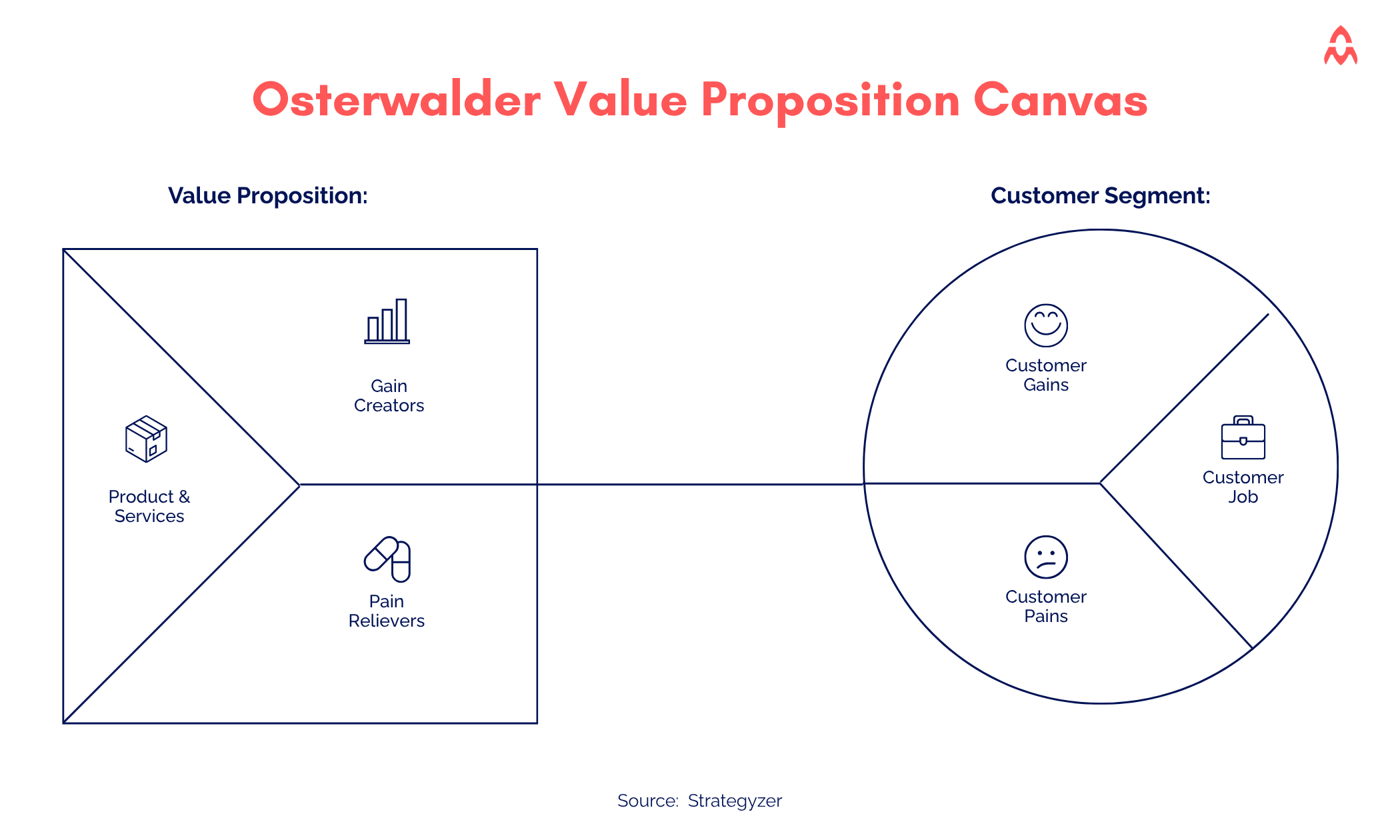
Developed by Dr. Alexander Osterwalder, this framework focuses on achieving product-market fit. The template is split into two parts: the customer profile, which covers customer jobs, pains, and gains, and the value map, which explains the pain relievers and gain creators from your offering. By aligning the customer profile with the value map, you can optimize resources by eliminating unnecessary features, ensure strong positioning by grounding value in proven capabilities, and establish a clear and consistent message across all marketing and sales efforts.
Steve Blank’s Value Proposition Formula
A quicker approach to defining your value proposition is Steve Blank’s formula. You have to fill in this sentence: “We help (X) do (Y) by doing (Z)”. When using this formula, the key is to be as clear and specific as possible. For instance, a statement like “We help businesses grow by providing better solutions” is generic and does not explain to the customer the value your services provide. A stronger example would be: “We help small retailers increase sales by 30% within six months through AI-powered inventory management that reduces overstock and prevents shortages.” This works because it names a specific audience, states a measurable outcome, and explains exactly how the product delivers it. The key distinction is specificity. The more precisely you can name who you serve, what changes for them, and how you make it happen, the more credible and compelling your value proposition becomes.
Geoffrey Moore Value Proposition Formula
Geoffrey Moore’s value proposition canvas template takes a more comprehensive approach by incorporating competitor analysis into the framework. The formula reads: “For [target customer] who [statement of need or opportunity], our [product/service name] is a [product category] that [statement of benefit]. Unlike [primary competitive alternative], our product [statement of primary differentiation].”This template is particularly beneficial in a competitive market, as it helps you clearly define what makes your product unique, providing deeper insights into your offering’s strengths and weaknesses and the market gaps you can own. An example of a value proposition statement following this approach would be: “For young professionals who struggle to save consistently, our app is a smart savings platform that automates and grows your savings through AI-driven insights. Unlike traditional banking apps, our product learns your spending habits and saves on your behalf, making financial discipline effortless.”
Dave McClure’s Elevator Pitch
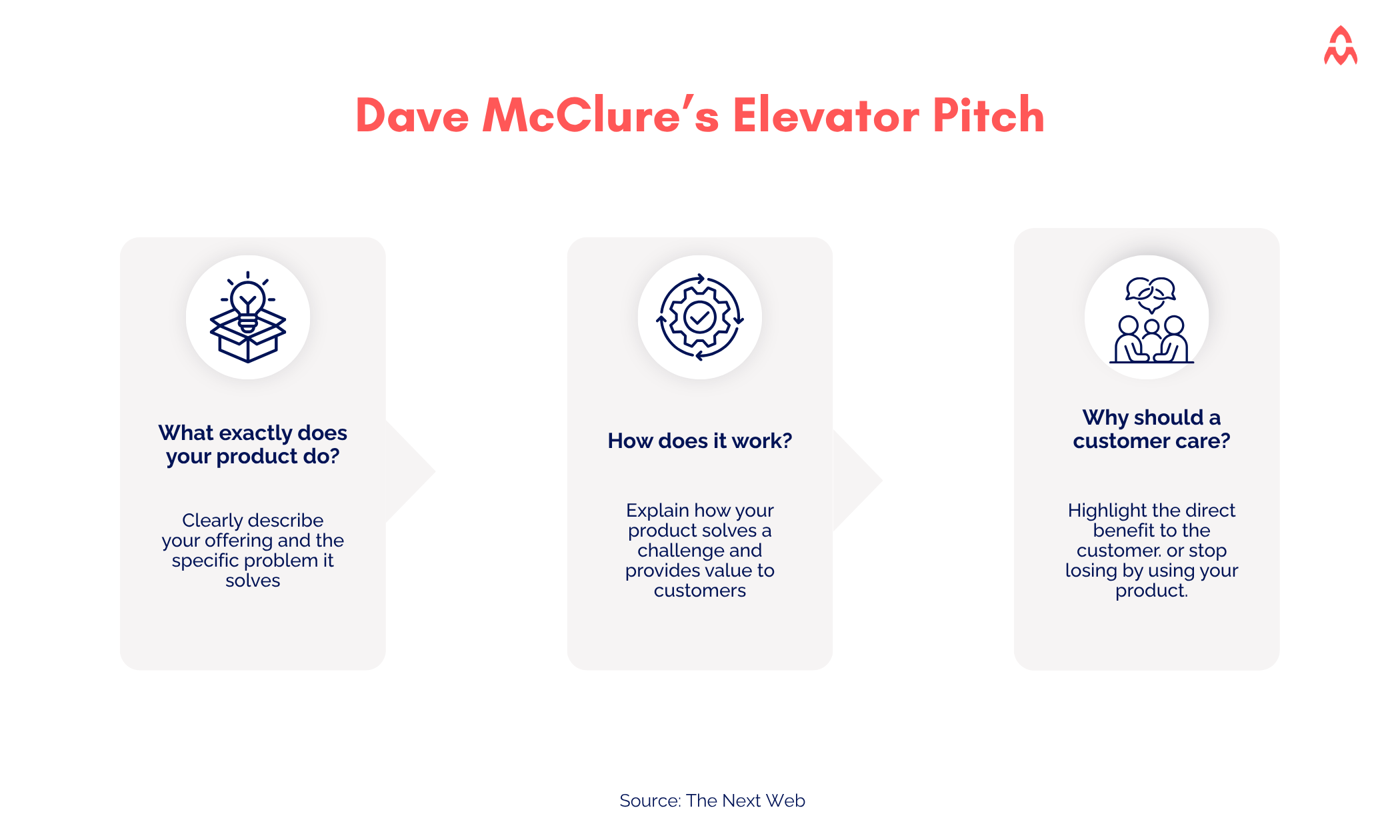
Often used in investor pitches, this framework distills your business's core proposition into three clear and memorable lines. The idea is to avoid jargon and communicate as concisely as possible, think of it as explaining the value of your product to an investor during a short elevator ride. To apply this framework, you must address three core questions: what exactly does your product do, how does it work, and why should a customer care? The emphasis is on simplicity and clarity above all else.
What Are the Key Elements of the Value Proposition Canvas?
The Osterwalder value proposition canvas consists of two sides: the customer segment and the value proposition. Unlike other frameworks that factor in competitors and positioning, this one focuses solely on understanding customer needs, laying the foundation for a strong business before anything else.
Here is what each of the elements of the canvas means:
Customer segment:
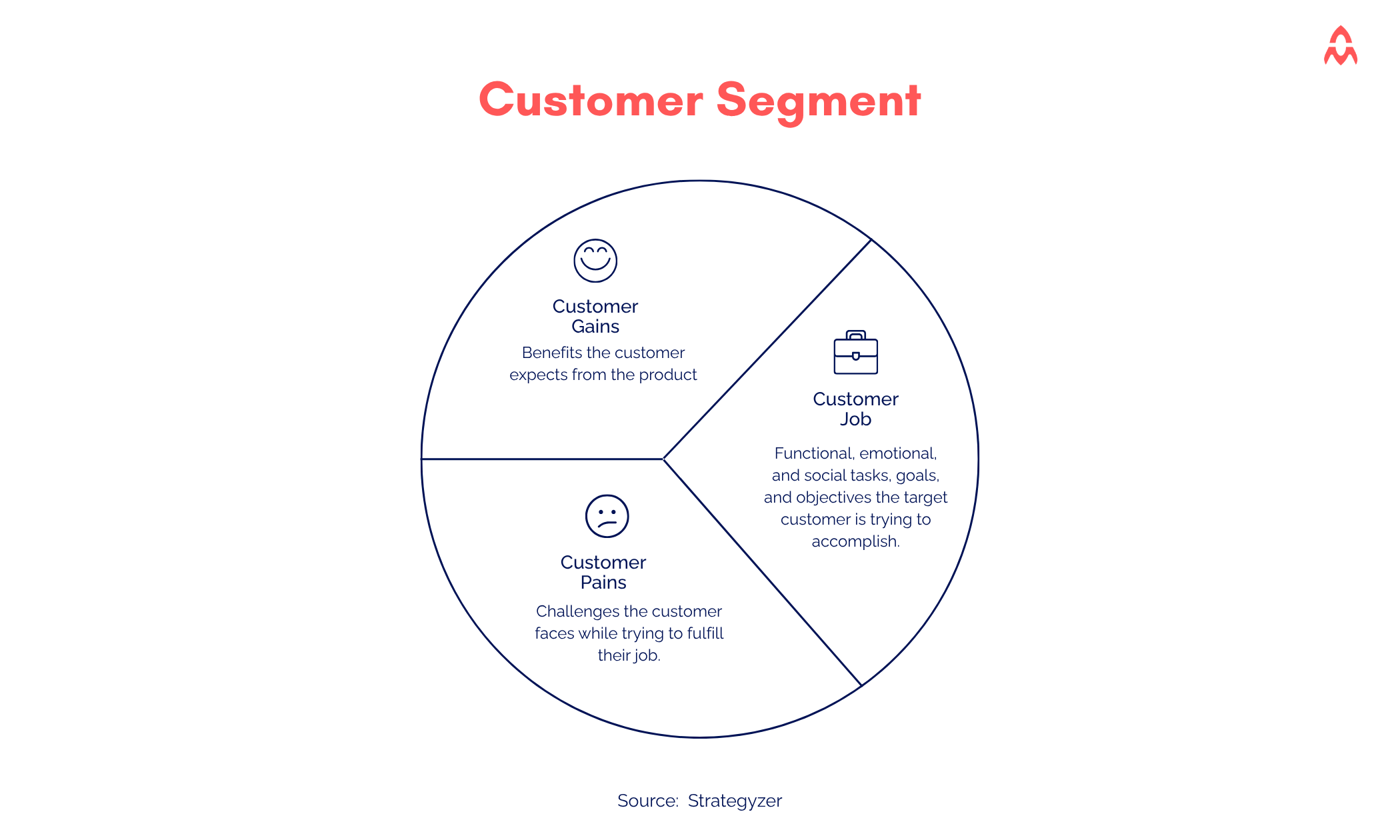
Customer Jobs: This section includes the functional, emotional, and social tasks, goals, and objectives the target customer is trying to accomplish.
Pains: These are the challenges the customer faces while trying to fulfill their job.
Gains: These are the benefits the customer expects and needs from the product, which would increase the likelihood of adoption.
Consider a healthtech startup focused on helping patients manage chronic conditions remotely. The customer job is to monitor health metrics, stay on top of medication schedules, and maintain regular communication with a care team, without disrupting daily life. The pain is the cost and inconvenience of frequent in-person consultations, as well as the difficulty of consistently tracking health data. The gain is peace of mind through timely, reliable health insights accessible from anywhere, reducing the need to visit a clinic for routine check-ins.
Value proposition:
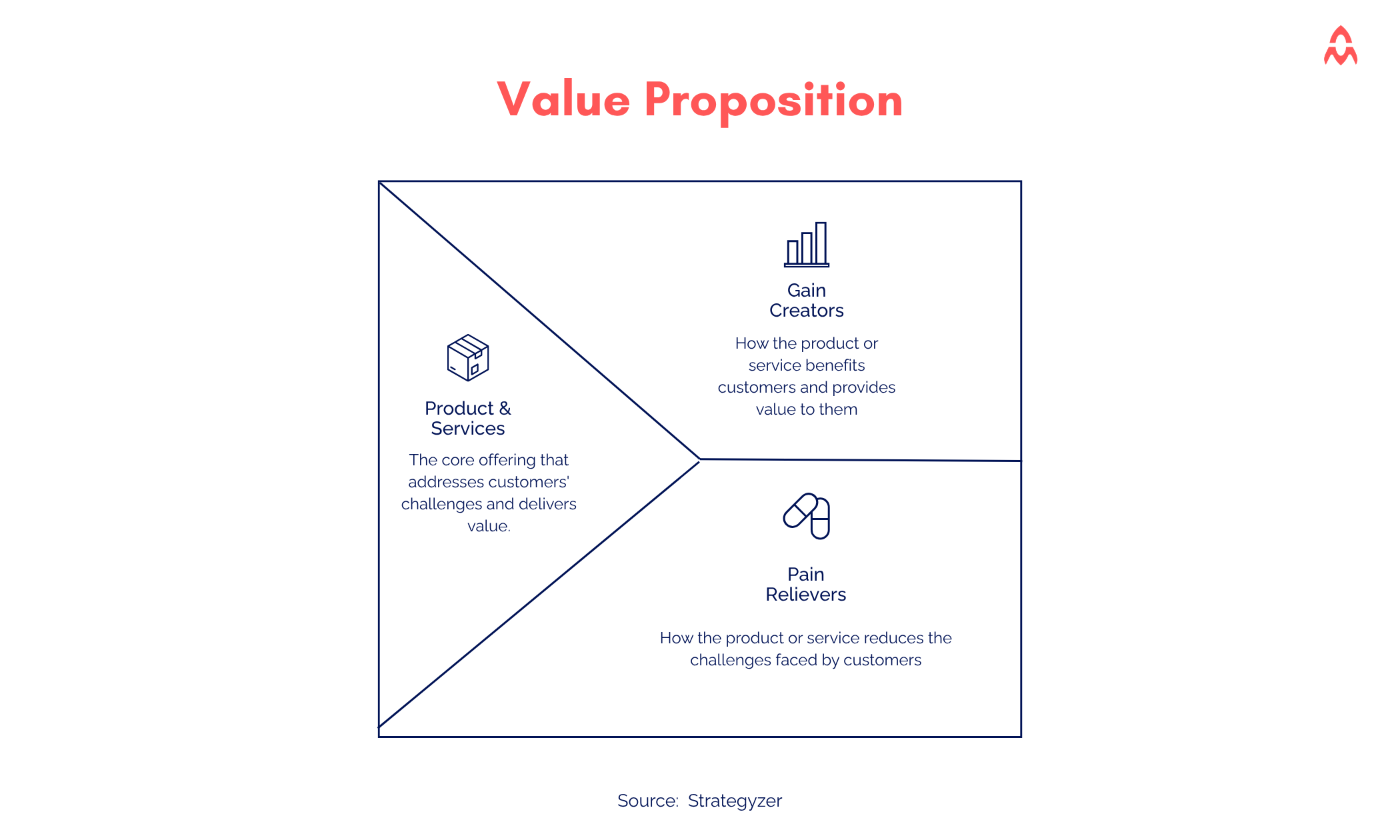
Gain creators: How the product or service benefits customers and provides value to them. The outcome should be specifically defined.
Pain relievers: How the product or service reduces the challenges faced by customers
Products and services: The core offering that addresses customers' challenges and delivers value.
For a healthtech startup, the gain creator would be providing instant, reliable health advice available 24/7. The pain reliever would eliminate the need for costly and time-consuming in-person consultations. The product would be an AI-powered health-monitoring app that tracks real-time health metrics and instantly connects users with medical professionals.
How to write a value proposition? Step-by-step guide
As a first-time founder, how can you go about developing a value proposition? The answer lies in following a structured approach that moves from understanding customer behavior and challenges to analyzing competitors and identifying the gaps you can own in the market.
Identify your target audience: Rather than targeting everyone, focus on a specific niche. Ask yourself: "Who is specifically struggling with the problem your product solves?" A well-defined target audience shapes every product decision that follows.
Understand your competitors: In order to create a value proposition statement, you have to study competitors and alternatives in the market. This helps you understand how to differentiate your offering and which gaps in the market to own. While conducting competitor analysis, ask yourself these questions: which customer problems are they targeting and which are they overlooking, how do they position themselves in the market, and what factors make a customer choose or not choose their product.
List the benefits of your product or service: Once you understand your target audience and competitors, the next step is to articulate how your product delivers value in ways others do not. This is where you identify your real advantages, whether that is a proprietary technology or process, a fundamentally different business model, better pricing or distribution, or a faster and more responsive customer experience. The goal is not to list every feature your product has, but to isolate the specific benefits that matter most to your target customer and that competitors are not delivering well. Those are the foundations of a credible value proposition.
Draft and refine your value proposition statement: With a clear understanding of your target audience, competitors, and the benefits of your offering, the final step is to draft your value proposition. Depending on the stage of growth or value that needs to be clearly communicated, proven formulas such as Steve Blank's "We help X do Y by doing Z" or Dave McClure's three-line elevator approach can be used. Other considerations include avoiding jargon and ensuring that product benefits are clearly defined. This is also not a one-time exercise. As markets evolve, customer needs shift, and competitors adapt, your statement will need to be revisited and refined regularly to remain relevant and compelling.
Consider the same healthtech startup example. Their target audience would be individuals who struggle to access timely and affordable medical advice. Analyzing their competitors, they would notice that existing solutions either charge high consultation fees or are difficult to navigate. Looking at the market, they would identify benefits such as an AI-powered instant consultation feature, affordable subscription pricing, and 24/7 availability as their primary differentiators. At the beginning of building their product, they can use the Osterwalder value proposition canvas to efficiently map customer pain points with their value proposition, and as they move forward, use Dave McClure's Elevator Ride to refine their value proposition statement.
Examples of Value Proposition Canvas: Lessons from Global Brands
A value proposition statement is not limited to any industry or niche. Global brands across sectors leverage this framework to communicate exactly why their product is needed in the market or why it should be chosen over a competitor.
Uber’s value proposition canvas:
Customer segment:
Customer job: Commuting from point A to point B safely, quickly, and conveniently
Customer pain: The challenges customers face include unreliable taxi services, cash dependence, and a lack of visibility into wait times or pricing.
Customer gains: Uber offers customers convenient transport services. By offering upfront pricing, cashless payments, and live GPS tracking, Uber set itself apart from traditional cab services.
Value proposition:
Products and services: A mobile-based application that connects customers with drivers, offering multiple service tiers like Uber Black and Uber X that suit different budgets and preferences.
Gain creators: Customers rely on Uber as it offers real-time driver tracking, estimated arrival and drop-off times, in-app cashless payments, and seamless ride scheduling.
Pain relievers: Uber eliminates price uncertainty with upfront fare estimates, reduces wait-time anxiety with live GPS tracking, and reduces the need for cash payments.
Apple’s value proposition canvas:
Customer Segment:
Customer job: Staying connected, productive, and creative through technology, whether for personal use or professional work
Customer pain: Before Apple, customers faced challenges such as poor device ecosystem integration, inconsistent software performance, and security vulnerabilities that compromised personal data.
Customer gains: Apple offers customers a seamless technology experience. By offering beautifully designed hardware, an intuitive operating system, and a tightly integrated ecosystem of devices and services, the company has become an industry leader.
Value Proposition:
Products and services: A premium ecosystem of products that includes the iPhone, Mac, iPad, Apple Watch, and AirPods, supported by services such as iCloud, the App Store, Apple Music, and Apple Pay, all designed to work seamlessly together.
Gain creators: Apple enhances the customer experience by ensuring seamless integration across devices, maintaining an intuitive user interface, and designing a product that feels personal and aspirational.
Pain relievers: Apple directly addresses customer frustrations by simplifying complex technology through intuitive design, eliminating compatibility issues across devices with its unified ecosystem, building robust security and privacy features to protect user data
Both Uber and Apple demonstrate how a well-constructed value proposition canvas moves beyond a generic product description to clearly articulate the specific ways in which their offerings provide value to customers.
In a market where capital is scarce and customers have endless alternatives, the ability to clearly communicate why your product matters is what separates ventures that scale from those that stall. Before raising capital or building a marketing strategy, founders need to be able to answer one question: why should a customer choose this over everything else available to them? The Value Proposition Canvas provides the structure to answer that question with precision rather than assumption. It helps ground the product in a deep understanding of customers, laying the foundation for stronger positioning, more effective marketing, and a venture people genuinely care about.
Partner with us
We are a social impact firm accelerating growth for organizations, governments & universities. Collaborate with Futurize to spearhead entrepreneurship programs, startup incubators, and inclusive innovation strategies to generate groundbreaking ideas and businesses for a sustainable future.