
Generative AI in Healthcare: Use Cases, Benefits, Challenges, and Future Outlook
What happens when the systems designed to keep us healthy can no longer keep up? Challenges such as rising costs of care, persistent medical inflation, funding cuts, and a shortage of healthcare workers are pushing traditional systems to their limits and widening the care gap.
Stakeholders globally are looking for effective solutions, with one option being Generative AI. With capabilities such as drug discovery and research, administrative automation, and personalized care, generative AI is emerging as a potential solution to improving the efficiency and capabilities of the healthcare sector.
What is Generative AI in Healthcare?
Generative AI in healthcare involves using advanced machine learning models, such as large language models (LLMs), to consolidate and analyze medical data, improve administrative efficiency, and facilitate personalized patient care.
Unlike traditional AI, which operates on structured data to automate workflows and support disease detection, generative AI can process vast amounts of unstructured data. This allows it to generate tailored treatment plans, assist in protein folding for drug discovery, and function as conversational healthcare agents.
Applications of Generative AI in healthcare: Key Use Cases
Usage of AI in healthcare goes far beyond clinical diagnosis and treatment, extending into operations, finance, and patient experience. This shift is playing out globally. Global health leaders expect technology to drive 56% of cost savings and revenue growth in 2026, as reported by Deloitte. This figure underscores the scale of AI's growing influence across the sector.

Improvements in administrative efficiency: Integrating generative AI into administrative functions can significantly improve efficiency and build a competitive advantage in the industry. Early adopters are using AI agents to automate and simplify quality management and regulatory processes, supporting risk management and continuous compliance monitoring, as mentioned in a Boston Consulting Group report. Beyond regulatory functions, these agents enable operators to detect potential risks, monitor key performance indicators, and recommend process optimizations that maximize bottom-line value. The impact is hard to ignore. A study titled “Generative Artificial Intelligence Use in Healthcare: Opportunities for Clinical Excellence and Administrative Efficiency published in the National Library of Medicine, stated that tools such as voice-to-text transcription and intelligent data entry are reducing the time spent on documentation by 21-30%. The result is a leaner, more responsive healthcare administrative infrastructure, which allows organizations to redirect resources and prioritize patient care and medical research.
Drug discovery and research: Generative AI is transforming the life sciences sector, particularly in drug discovery, clinical trials, and precision medicine. Its ability to analyze massive datasets allows it to identify potential drug candidates, predict side effects, and repurpose existing drugs, dramatically reducing development time and costs. In clinical trials, these capabilities help anticipate challenges and improve overall efficiency. Global giants such as Pfizer and Janssen are already leveraging generative AI for drug discovery and design, signaling a broader shift in how AI in healthcare projects is being utilized.
Patient engagement and support: A growing trend in healthcare is patients utilizing AI for their personal health. A Boston Consulting Group report found that 57% of respondents already use AI tools for health-related queries, and this is particularly evident in emerging markets such as India, Brazil, and China, where patients are using tools like Gemini and ChatGPT to fill gaps in access to care. While this enables patients to stay informed about their health, it also carries risks of inaccurate responses and outdated medical information, which could lead to misinformed decisions. Healthcare professionals, by contrast, are leveraging the technology within appropriate compliance and regulatory frameworks. AI-powered virtual assistants and chatbots are reducing the burden on human operators by managing appointment scheduling, prescription refills, and basic medical guidance, enabling patients to access support instantly and independently. Beyond operational support, these systems can analyze individual patient data to deliver personalized communications and reminders that support medication adherence and overall well-being, offering a safer and more reliable model of AI-assisted patient engagement.
Personalized clinical care and diagnostics: Generative AI is making personalized clinical care at scale an increasingly achievable reality. With the ability to analyze vast datasets, it can predict patient outcomes and suggest optimal treatment plans, helping healthcare providers intervene earlier, personalize care strategies, and reduce the cost burden on patients. For instance, the same National Library of Medicine study reported that deep learning models were used to predict cardiovascular risk factors from retinal images and to pinpoint biomarkers, thereby helping formulate precise and personalized treatment plans. Meaningful traction is being observed globally. In the US, hospitals are actively testing generative AI for patient interactions and personalized care plans. In Africa, startups are developing technologies that support early intervention and detection of diseases such as cancer and tuberculosis, addressing some of the continent's most persistent public health challenges.
What are the Benefits of Generative AI in Healthcare?
The healthcare system is increasingly becoming human-centered, moving from reactive to proactive patient care, and Generative AI is playing a significant role in this shift. The benefits of AI in healthcare are being felt across the board, improving access to quality care for patients, reducing the burden on healthcare workers, and enabling institutions to operate more efficiently and effectively.
Increased qualitative care delivery: Organizations leveraging generative AI are enhancing the quality of care delivered to patients, physicians, and other key stakeholders. An example is surgical care. Johnson & Johnson’s MedTech unit and NIVIDI have collaborated to integrate AI to streamline the surgical journey. The applications include introducing real-time AI annotations in urologic robotic surgeries, enhancing decision-making during surgery through personalized risk assessments, and automating the extensive postoperative documentation process. While this currently requires human supervision, Gen AI is being successfully leveraged in surgical care. Before a procedure, surgeons are required to process large volumes of data, such as patient history and laboratory results. Gen AI models can rapidly integrate and analyze these complex datasets, supporting faster surgical decision-making and improving treatment timeliness.
Streamlined care operating model: AI automation in healthcare is proving extremely beneficial for optimizing models and improving efficiency. These productivity gains are not restricted to a particular function. For claim management and reimbursements, Gen AI can streamline processing, generate summaries of denied claims, and identify solutions, reducing manual effort in this area by 50-75%, as per McKinsey’s research. For patients, it supports continuity of care by synthesizing discharge information, referral summaries, and specialist notes, ensuring that patient information flows seamlessly across care teams. Its capabilities are also being tested to create personalized training journeys and workflow materials, contributing to a more skilled and better-supported healthcare workforce.
Ensuring access to quality care for all and improving health outcomes: Access to quality care for all citizens is a major challenge faced by governments worldwide, and generative AI is emerging as a viable solution. Integrating Gen AI with telehealth platforms and wearable devices can deliver real-time health reporting, reducing dependence on in-person consultations and making quality care more widely accessible. This is corroborated by the Boston Consulting Group, which found that the majority of people are already using Gen AI tools to access health information and seek medical advice because these tools are largely free or low-cost, available 24/7, and capable of delivering tailored responses. Beyond access, Gen AI is also improving overall health outcomes. The same study found that AI-enabled wearables are being used several times per week or daily by 58% of respondents and AI sleep tracking by 49%, reflecting a growing trend of patients taking a more proactive and informed approach to managing their own health.
Improvement in healthcare worker well-being: Burnout is a significant challenge facing healthcare systems worldwide. A study titled “Factors associated with burnout among healthcare providers in a rural context, South Africa,” published in the National Library of Medicine, reported that low levels of well-being among healthcare workers in South Africa led to absenteeism and resignations, further exacerbating the healthcare crisis. Generative AI is helping to address this directly. Administrative optimization from Gen AI integration is saving nurses 37% to 46% of their time, amounting to about 32 to 40 hours a year and reducing the burden on staff. These models also facilitate improved cognitive load management, with large language models drafting empathetic responses to online patient queries, freeing healthcare workers to prioritize other essential tasks. The technology is also being leveraged by physicians for planning and simulation, improving confidence in critical situations. This is not just in theory. Companies such as Axtria are integrating Gen AI into their daily operations to improve physician care and core information management capabilities.
What are the key barriers to healthcare AI adoption?
The use of generative AI in the healthcare industry presents significant benefits, but adoption comes with challenges that warrant careful consideration. For the technology to scale responsibly and deliver equitable outcomes, policymakers and healthcare practitioners must account for these barriers in their strategies.
Algorithmic biases: The key challenge with gen AI use in healthcare is the presence of algorithmic biases. AI algorithms rely on datasets with valuable information such as historical health records, treatment outcomes, and patient demographics. However, if these records contain human biases, AI is likely to replicate them. For instance, a Harvard report titled “Confronting the Mirror: Reflecting on Our Biases Through AI in Health Care” stated how AI can predict a lower health risk for a demographic not because they are healthy, but historically have received lower access to care. To mitigate this challenge, healthcare providers must take proactive measures, including diversifying data sources, continuously monitoring and updating information, and engaging all interdisciplinary stakeholders in conversations about generative AI in healthcare.
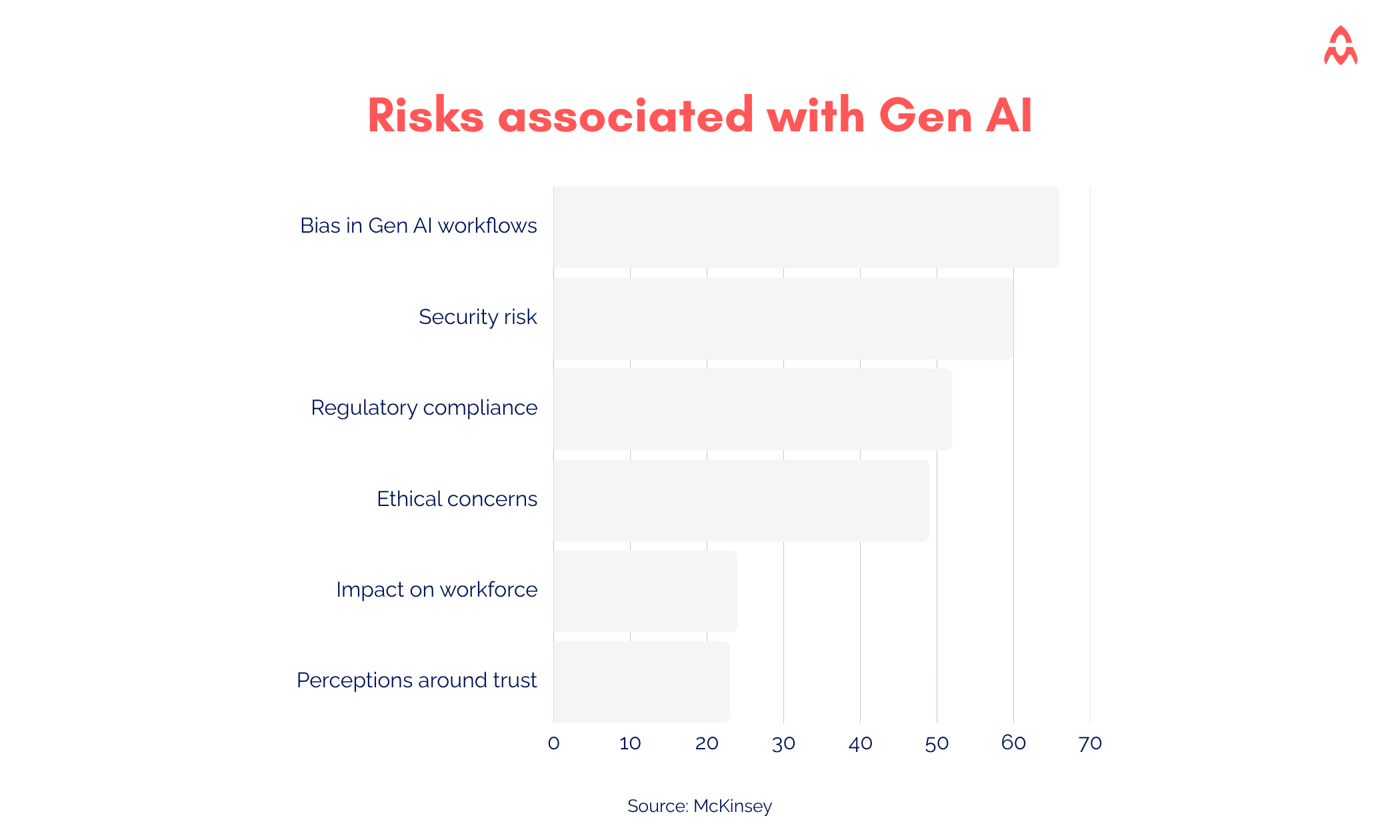
Lack of an ethical framework: Gen AI adoption in healthcare cannot be successful without the presence of a framework that prevents algorithmic biases, data misuse, and ensures privacy for all stakeholders. The World Health Organization has reported that, in many cases, the use of AI in health diagnosis does not align with legal safeguards, with only 8% of countries having liability standards. This is mirrored by patients, with 53% stating that their confidence depends on the presence of clear governance and ethical design. Regulatory pressures are another concern. Mental health platform Woebot was shut down despite being clinically validated because of a lack of clear FDA guidelines with respect to AI-based mental health tools. The growth of AI in healthcare depends on the establishment of a strong regulatory and ethical framework.
Difficulty in workflow integration: Many healthcare organizations worldwide are prioritizing AI adoption but cite integration challenges and a lack of internal capabilities as significant barriers to scaling. Embedding AI into complex legacy systems remains a particularly difficult undertaking, often requiring extensive workflow redesign that significantly drives up costs. Beyond the technology itself, organizations must also invest in employee training and continuous education to ensure staff can effectively use and adapt to these tools. High costs and risks associated with data misuse are additional considerations that must be addressed early, during the planning and proof-of-concept stages, before resources are committed.

Data security and privacy concerns: The biggest area of concern in Gen AI adoption is data security and privacy. A McKinsey survey found that 43% of healthcare leaders identify risk and safety as a direct roadblock to implementation, with inaccuracies, security vulnerabilities, and regulatory compliance consistently ranking among their top concerns. Ethical and privacy considerations are also frequently cited, reflecting the sensitivity of the data that these systems handle. To mitigate this challenge, healthcare practitioners should prioritize building robust data governance frameworks from the outset, establishing compliance protocols, conducting regular audits, and implementing clear data usage policies.
Future of health care: Can Gen AI transform the health landscape?
The challenges facing global healthcare are significant, but so is the potential of generative AI to address them. While in 2025 the healthcare industry was in the planning phase, in 2026 the outlook points to full-scale adoption, with breakthroughs in personalized care, synthetic data generation, and AI-driven diagnostics. The numbers reflect this momentum. NVIDIA's 2026 State of AI in Healthcare and Life Sciences survey projects that over 70% of healthcare organizations will have integrated AI into their workflows by 2026, while the global generative AI in healthcare market, valued at $1.6 billion in 2022, is projected to reach $30.4 billion by 2032, growing at a compound annual growth rate of 34.9%.
This growth, however, does not come without challenges. Sustaining the momentum requires strict regulatory frameworks, strong ethical standards, and deeper collaboration between all stakeholders. This will ensure that the benefits of generative AI in healthcare are equitable and promote the growth of the entire industry.
Partner with us
We are a social impact firm accelerating growth for organizations, governments & universities. Collaborate with Futurize to spearhead entrepreneurship programs, startup incubators, and inclusive innovation strategies to generate groundbreaking ideas and businesses for a sustainable future.