
4 Types of Innovation in Business: Process & Examples
Over the past few decades, technological advancements and rapid innovation have led to stiff competition across industries and sectors as organizations develop offerings that boost productivity, reduce waste, and build competitive advantage. Innovation sparks new ideas, creates new products, and introduces new methods, challenging the status quo and propelling industries forward.
Satell Greg, while researching for his book ‘Mapping Innovation,’ found that every innovation strategy eventually fails. There is no single right path to innovation in business, and companies should stop relying on a single approach to solve multiple problems. Innovation is more like a set of tools to achieve some predefined end goal, and organizations must create a portfolio of innovation strategies to use the most relevant one when the situation demands.
What are the 7 Steps of the Innovation Process?
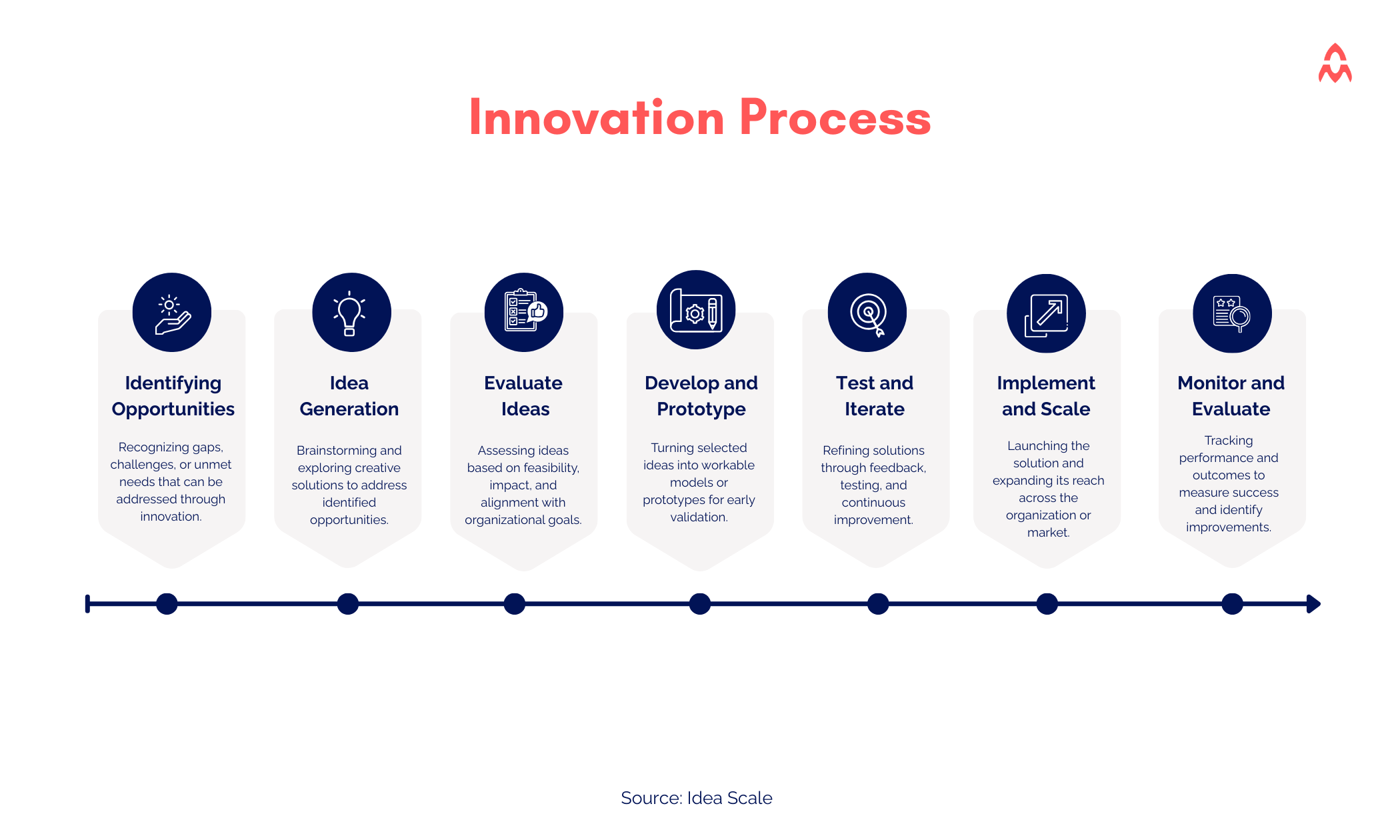
Identifying Opportunities: The first step in the process of innovation is identifying opportunities where innovation can make a meaningful impact. The aim is to identify unmet customer needs, emerging market trends, and potential areas for improvement through market research, customer surveys, or internal assessments.
Generate Ideas: Once potential opportunities are identified, focus shifts to developing innovative solutions to pressing challenges through brainstorming, customer feedback, and cross-functional collaboration.
Evaluate Ideas: The third step in the innovation process is to evaluate the merit of all ideas and select the most promising. Based on factors such as market potential, technical feasibility, and alignment with organizational goals, ideas that warrant further investment are finalized.
Develop and Prototype: The fourth step involves turning the selected ideas into tangible prototypes or minimum viable products (MVPs). The focus is on assessing the concept's validity, gathering feedback, and further refining the solution based on suggestions.
Test and Iterate: In this phase of the innovation process, the prototype is validated with customers and under real-world constraints. This helps confirm assumptions, identify challenges, and refine the innovation before large-scale implementation.
Implement and Scale: Once the prototypes have been tested and the design has been iterated based on feedback, the idea is implemented in the market. The step involves strategizing an implementation plan, allocating resources, and ensuring collaboration between all team members during the process.
Monitor and Evaluate: The innovation process does not stop after the product has been introduced in the market. Organizations need to evaluate performance and the solution's impact by establishing key performance indicators (KPIs) to assess whether the innovation is successful and whether refinements are required for the product's long-term success.
For example, Spotify applies this innovation process by identifying that listeners struggle to discover new music, generating ideas through data insights and team collaboration, developing and testing features like personalized playlists and yearly recaps with small user groups, and continuously refining these solutions before scaling them to millions of users.
What is the Innovation Matrix?
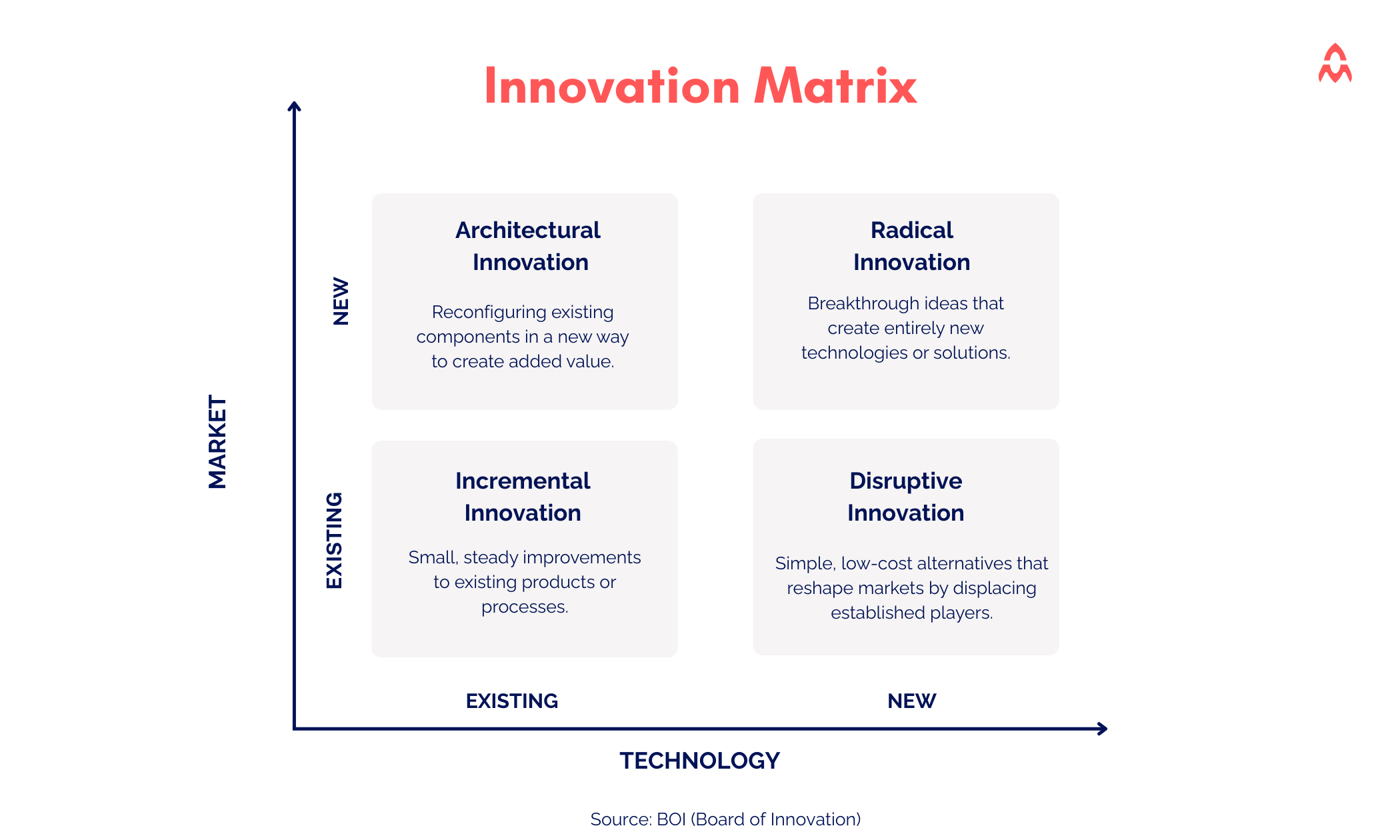
An Innovation Matrix is a strategic tool that helps organizations categorize and evaluate different types of innovation based on market needs and technological capabilities. The framework provides leaders with clarity on where to allocate resources, supports risk management by identifying which innovations are most likely to create value, and enhances collaboration by aligning teams around shared innovation goals.
Types of Innovation and Examples
Business innovation manifests in various forms, each with its unique impact and approach. We’ve broken down four different types of innovation and examples of innovation, each based on current or emerging technological solutions that help transform existing marketplaces or create new ones. These fundamental types are categorized as incremental, disruptive, radical, and architectural and are vital for sustaining business growth and responding to market demands:
1) Incremental Innovation
Market: Existing
Technology: Existing
Description: Small improvements to existing products, services, or processes targeting familiar markets with well-understood technology.
2) Radical Innovation
Market: New
Technology: New
Description: Breakthrough innovation that establishes new markets and involves novel technologies, potentially disrupting or creating new industries.
3) Disruptive Innovation
Market: Existing
Technology: New
Description: New technology is applied to an existing market, offering a new value proposition and potentially overtaking established market leaders over time.
4) Architectural Innovation
Market: New
Technology: Existing
Description: Existing technologies applied to new markets involve reconfiguring product or system components for new applications or uses.
Incremental Innovation
Incremental innovation involves small, gradual changes or improvements to a company's existing products, services, processes, or methods. It's about enhancing what already exists to improve efficiency, productivity, and competitive differentiation. The approach is less about breaking new ground and more about refining and optimizing, ensuring that a product or service remains relevant and appealing over time. Incremental innovation is widespread in consumer technology, where companies regularly update personal devices with customer-friendly features. It represents a lower-risk strategy focused on maintaining or improving a product's market position by making it better rather than different. A prime example of incremental innovation is the evolution of smartphones like the Apple iPhone. Each new model introduces improved cameras, longer battery life, and more efficient processors, enhancing user experience and value without reinventing the wheel.
Examples of incremental innovation:
Gillette: Gillette has employed incremental innovation by evolving its razors from single-blade to multi-blade models and adding features over time. This approach has helped Gillette better meet customer needs and stay ahead of the competition.
Coca-Cola: Coca-Cola has introduced line extensions such as Cherry Coke, Coke with Lime, and Coca-Cola Life. These innovations have enabled the 130-year-old brand to remain relevant, tap into emerging trends, and offer new options to its customers.
Cadbury: Similar to Coca-Cola, Cadbury has introduced new product flavors and formats. An example is the Wispa chocolate bar, which is now available as hot chocolate and a snacking bag. Cadbury has opened up additional revenue streams by adopting an incremental approach to innovation.
Disruptive Innovation
Disruptive innovation, on the other hand, refers to the innovation that fundamentally changes how a market or industry operates through new technology. It results in unique offerings that challenge and replace traditional products, services, or approaches. This strategy often starts by targeting overlooked or niche markets, for instance, utilizing AI in education or developing technologies for healthcare challenges, before moving into the mainstream, fundamentally altering the competitive landscape, displacing established competitors, and reshaping industry dynamics. Disruptive innovations are a medium-to-high risk. Many fail, but as they usually use low-cost resources, the cost of failure is often manageable.
Examples of disruptive innovation:
Netflix: Netflix is a textbook case of disruptive innovation. It started by offering DVD rentals by mail, a service that catered to an online shopping audience overlooked by traditional video rental stores. As technology evolved, Netflix disrupted the entertainment industry further by introducing streaming services, making physical rentals obsolete, and changing how people consume media.
Uber: Uber disrupted the traditional taxi service industry by introducing a ride-sharing app that connects drivers with passengers directly, bypassing the conventional taxi dispatch system. This innovation not only improved convenience for users but also offered a flexible work option for drivers. Uber's model has significantly impacted urban transportation globally, prompting regulatory and business model adjustments in the taxi industry.
Airbnb: Airbnb disrupted the hospitality industry by enabling homeowners to rent out their rooms or properties to guests through an online platform. This model has significantly expanded lodging options for travelers, providing a unique and often more affordable alternative to hotels. Airbnb's approach has challenged traditional hotel business models, leading to discussions and changes in regulations, taxation, and competition strategies in the lodging sector.
Radical Innovation
Radical innovation is a transformative force in today’s business and societal landscape. It is characterized by its ability to fundamentally alter industries, introduce groundbreaking advancements, and disrupt established markets. Unlike incremental innovation, which focuses on gradual improvements, radical innovation involves creating new technology and opening new markets. Radical innovation is characterized by its transformative impact, high uncertainty, and breakthrough thinking. Open innovation strategies can be very effective, as they help solve complex problems in new ways by involving various stakeholders.
Examples of radical innovation:
Salesforce’s cloud technology: The company developed cloud technology and the software as a service (SaaS) business model early in 1999. This new technology created a new market for corporate clients looking for a software solution to manage customers and was considered a truly radical innovation in its time.
SpaceX’s reusable rockets: Space Exploration Technologies Corp. (SpaceX), another venture by Elon Musk, has introduced the concept of reusable rockets to the aerospace industry. Traditionally, rockets were single-use vehicles, discarded in the ocean after launch, making space exploration exceedingly expensive. SpaceX developed the Falcon series of rockets, capable of returning to Earth after launch and being refurbished for subsequent missions. This innovation drastically reduces the cost of accessing space, making it more feasible for satellite deployments, scientific research, and even human spaceflight. SpaceX’s reusable rockets are a cornerstone in the company's ambition to make space more accessible and eventually enable human life on Mars.
3D printing/additive manufacturing: 3D printing technology, or additive manufacturing, has emerged as a radical innovation within the manufacturing sector as it enables the creation of physical objects from digital designs by layering materials such as plastic, metal, or concrete. The technology has significantly impacted prototyping, allowing for rapid iteration and development of new products at a fraction of the cost and time of traditional manufacturing methods. Beyond prototyping, additive manufacturing revolutionizes production by enabling on-demand, customized production runs and reducing waste material. Its applications span industries, including aerospace, automotive, healthcare (for custom prosthetics and implants), and construction, promising to redefine manufacturing processes worldwide.
Architectural Innovation
Architectural innovation involves reconfiguring existing product technologies to create new markets by applying proven components in novel ways. This strategy focuses on reimagining how current technologies can be integrated or deployed differently, creating fresh opportunities to attract customers who have not previously engaged with the existing offering.
It often leverages the product's systemic architecture, meaning it changes the overall design or system without altering the core technology components. This type of innovation could entails diminishing returns, as there is a limited amount of value that companies can derive from an existing mix of technologies.
Examples of architectural innovation:
Sony Walkman: Sony did not invent portable music or headphone technology; however, by reconfiguring the existing technology into a compact, portable cassette player explicitly designed for personal use, Sony created a new market for personal listening devices. This innovation changed how people consumed music, making it individual and portable.
Toyota’s Prius: Toyota's introduction of the Prius, the first mass-produced hybrid vehicle, is an example of architectural innovation. Toyota combined existing internal combustion engine technology with electric motor technology to create a new category of environmentally friendly vehicles. This innovation did not require the invention of new technology but rather the novel integration of existing technologies, creating a new market for hybrid vehicles.
Smartphones: While not attributable to a single company, the development of smartphones represents architectural innovation by combining the functions of a mobile phone with that of a handheld computer. Early mobile phones and personal digital assistants (PDAs) existed separately; smartphones integrated these functionalities into one device, along with camera, GPS, and internet connectivity. This reconfiguration of existing technologies created a new market for smartphones, fundamentally changing how people communicate, access information, and use technology daily.
What are the Ten Types of Innovation? Doblin’s Innovation Model Explained
The Ten Types of Innovation model developed by Doblin emerged from an extensive study of thousands of breakthrough ideas across industries. Their research showed that successful innovations share a standard set of building blocks that span how a company is organized, what it offers, and how it engages customers. These elements are grouped into three broad categories that represent the full spectrum of innovation.
The first category, configuration, focuses on how the business is designed behind the scenes, including its approach to generating revenue, forming partnerships, structuring teams, and running internal operations.
The second category, offering, highlights the core value delivered through products and services and how well these components work together as a unified system.
The third category, experience, emphasizes the outward-facing aspects of the business, from the services that support the offering to the channels that deliver it, the identity that shapes customer perception, and the methods used to inspire deeper user participation.
Organizations can apply this innovation model to evaluate the strengths and gaps within their current offerings, assess their overall innovation maturity, or uncover new opportunities for differentiation in any market.

Conclusion
Innovation is pivotal in business and other creativity-driven ventures, guiding organizations aiming for growth, sustainability, and a competitive edge. It conceptualizes new ideas, products, or methods that challenge the norm and drive industries forward. Innovation isn't merely about inventing new things; it's about delivering value in new ways, fulfilling emerging customer needs, and adapting to or defining market trends. Adopting innovation is essential for survival and success in the current business environment, offering advantages like competitive differentiation, enhanced efficiency, improved customer experiences, and access to new markets. If your current innovation model or strategy is not hitting the mark, it’s because you’ve gotten trapped with a ‘single’ approach. There will always be newer and more complex problems that organizations must solve differently. Understanding the best type of innovation to achieve your desired goal will be crucial for achieving long-term success and relevance.
Partner with us
Join us as a partner at Futurize to spearhead innovation and entrepreneurship programs to generate groundbreaking ideas and businesses for a sustainable future. Get in touch with us by filling out the form below.